
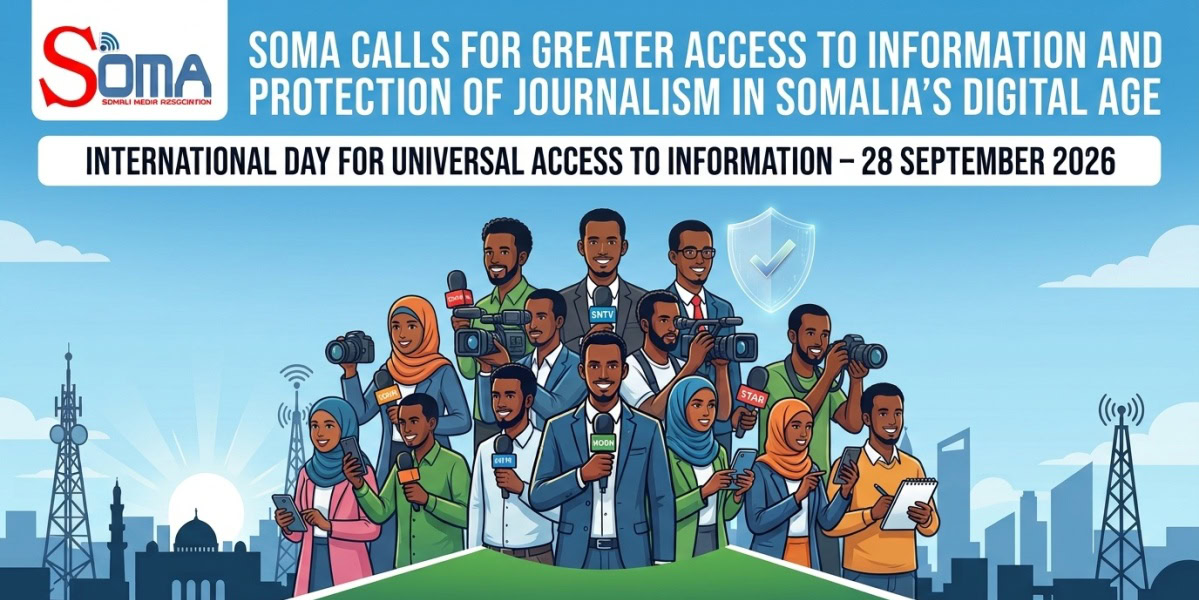
PRESS STATEMENT
International Day for Universal Access to Information – 28 September 2026
Mogadishu, Somalia – 28 September 2026.
The Somali Media Association (SOMA) joins the global community in commemorating the International Day for Universal Access to Information, observed annually on 28 September. The day recognizes the importance of access to information in promoting transparency, accountability, informed public participation, and inclusive societies. UNESCO has recognized 28 September as the International Day for Universal Access to Information at the international level.
On this occasion, SOMA calls on the Federal Government of Somalia, Parliament and all public institutions to strengthen access to public information and create an enabling environment in which journalists can perform their professional responsibilities safely, independently and effectively.
Continued Challenges in Accessing Public Information
Over the past four years, journalists in Somalia have continued to face challenges in accessing public information and government institutions. While journalists have generally been able to access the two chambers of Parliament—the House of the People and the Upper House—access to other government institutions has remained limited.
Even within Parliament, journalists are at times restricted from covering certain proceedings and public events. Such restrictions can limit the ability of journalists to provide the public with timely and comprehensive information about matters of public interest.
SOMA believes that access to government information should be based on clear, transparent and predictable procedures. Journalists should not have to rely solely on individual permissions or informal arrangements to access information that is legitimately in the public interest.
Emerging Challenges in the Digital Environment
The media environment has also changed significantly with the rapid growth of digital journalism. Digital platforms have become an essential part of professional journalism, enabling media institutions to report breaking news, reach wider audiences and provide information directly to the public.
However, this development has also brought new challenges. Media institutions and journalists increasingly face restrictions affecting the digital space. In some instances, content that authorities consider undesirable may be removed, while access to social media platforms or accounts may be restricted or blocked.
These developments create additional challenges for professional media institutions, particularly at a time when digital platforms have become an important channel for news gathering, reporting and public communication.
SOMA stresses that any restrictions affecting journalists or media content should be based on clear legal provisions, follow due process and respect legitimate journalistic and public-interest reporting.
“Access to information is fundamental to responsible journalism and to an informed public. Journalists need timely, reliable and lawful access to information so that citizens can understand issues that affect their lives and participate meaningfully in public affairs. Strengthening access to information is therefore not only a media concern, but also an important part of transparent and accountable governance.”
— Mohamed Abduwahab, Secretary General, Somali Media Association (SOMA)
SOMA’s Continued Engagement on Access to Information
SOMA has consistently used the International Day for Universal Access to Information as an opportunity to promote dialogue among media institutions, government institutions, Parliament, security institutions, civil society and other stakeholders on challenges related to access to information and journalists’ safety.
The concerns and recommendations raised through these engagements have also informed SOMA’s subsequent activities. In 2025, discussions involving media institutions, Parliament, the Ministry of Information, the Somali Police Force and civil society highlighted the challenges journalists face in obtaining public information and the importance of strengthening legal and institutional mechanisms to protect access to information and journalism.
One of the recommendations arising from these discussions was the need to strengthen understanding and cooperation between the police and media through practical engagement and training.
In response, SOMA conducted police–media engagement training sessions in 2026, bringing together police officers and media professionals to strengthen their understanding of their respective roles, responsibilities and professional standards. The sessions provided an opportunity to discuss issues including journalists’ rights and safety, professional conduct, access to information, communication during public events and the responsibilities of security institutions when engaging with the media.
SOMA is encouraged by the progress made in the working relationship between the police and media. Continued dialogue and practical engagement have contributed to improved understanding and cooperation between the two sides. SOMA remains committed to supporting this progress and promoting constructive and professional police–media relations.
“Our experience shows that dialogue between the media and public institutions can make a practical difference. The police–media engagement sessions conducted by SOMA in 2026 demonstrated the value of bringing journalists and security institutions together to better understand their respective responsibilities. We encourage all stakeholders to build on this progress through continued communication, cooperation and respect for professional standards.”
— Mohamed Abduwahab, Secretary General, Somali Media Association (SOMA)
SOMA’s Calls
On this International Day for Universal Access to Information, SOMA calls on:
- The Federal Government of Somalia to strengthen transparency and ensure that public institutions provide timely and accessible information to journalists and citizens.
- Parliament to strengthen the legal framework governing access to information and ensure that journalists and citizens have meaningful opportunities to access information of public interest.
- Government institutions to establish clear and consistent procedures for journalists seeking access to public information, facilities and events.
- Security institutions to respect the professional role of journalists and ensure that legitimate security considerations are not used unnecessarily to restrict lawful reporting.
- Relevant authorities to ensure that measures affecting digital media and online content are transparent, lawful and subject to appropriate safeguards.
- Government and media stakeholders to maintain regular dialogue and cooperation to address challenges related to access to information and journalists’ safety.
- Media institutions and journalists to continue upholding professional standards, accuracy, verification and responsible reporting while exercising their right to seek and disseminate information.
A Shared Responsibility
SOMA emphasizes that universal access to information is not solely a media-sector issue. It is an important component of transparent governance and an informed society. Government institutions have a responsibility to communicate with the public, while journalists and media institutions have a responsibility to report information accurately, fairly and responsibly.
As Somalia continues to strengthen its institutions, SOMA believes that improving access to information should remain a shared priority among government institutions, Parliament, security agencies, civil society, media institutions and the wider public.
SOMA reaffirms its commitment to advocating for improved access to information, supporting professional journalism, strengthening constructive engagement between the media and public institutions, and promoting an environment in which journalists can safely and independently serve the public interest.